Monthly Archives: February 2012

Achievment of the Week: Zulfa’s Story

We had a great workshop at Kibo last week where we began by recapping what we’ve learnt so far and then introduced a new topic, an opinion.

We started by thinking about the meaning of this and why it is important to have one. After a few minutes of thinking and hinting at some possibilities Ibraham contributed,  ‘ it is important to have one because if something bad happens you can do something about it.’ The MSMV co-ordinator of Kibo then continued and explained relatively what this could mean. She started off with something simple, a mobile phone, do you like it? Why? Then she exemplified the school, how about your teachers and the Head Teacher, do you think they teach well? She then went on to ask what about you’re country? An opinion would be if you thought it was being run well, or badly! We were literally dancing with excitement, this was a brilliant analogy and came straight from the teacher. I also noted that she retained a beaming smile on her face throughout the afternoon.

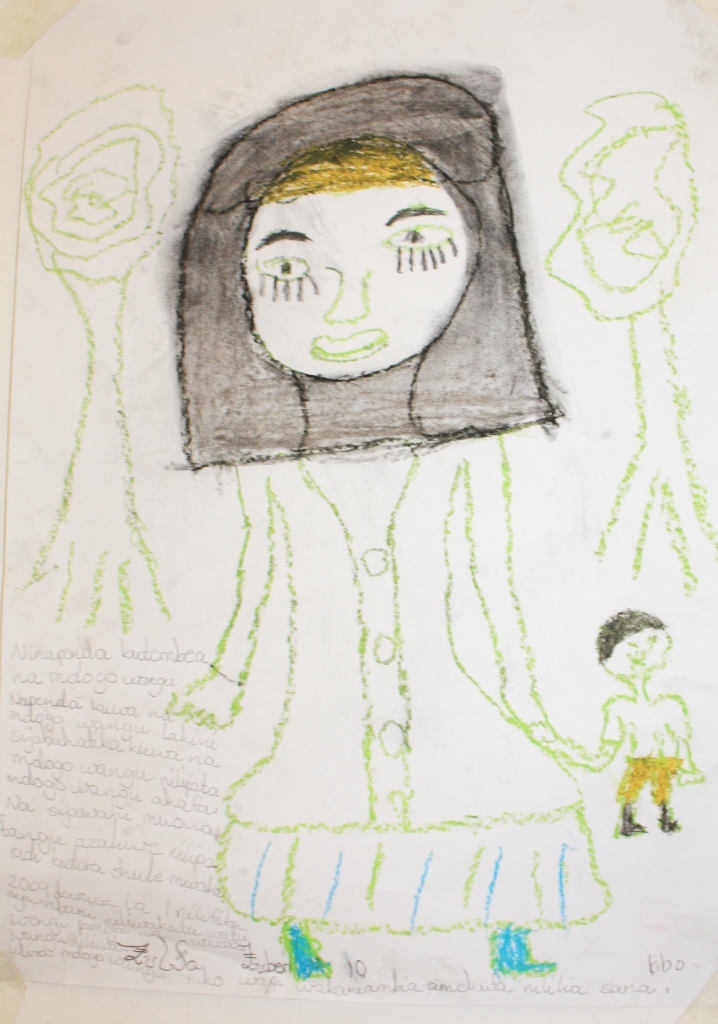
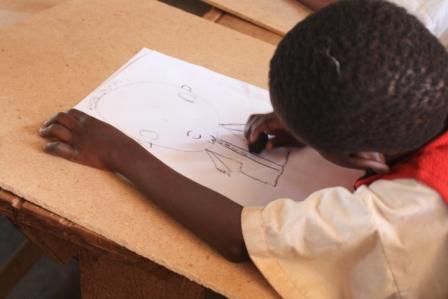
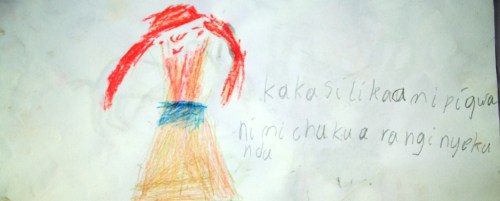
If this wasn’t good enough, after the workshop which focussed on experimenting with making marks and unique styles, we each produced a self portrait and asked the students to include an indicator of who they are, not just what they look like.  During the presentations Zulfa, who had at previously written in our baseline survey that she could not present herself in class, and could not express her feelings through art, proudly stood up on a chair and eloquently told her story. She had drawn a beautiful picture of her holding her baby sisters hand who had unfortunately died a couple of years ago. Following is the translation of her accompanying text.

‘I like walking with my young sister and I love having one, but I’m not lucky, I don’t have one. I did have but she died and I didn’t even get a chance to see her. When I came home from school in 2009 when I was in standard 1, I went home and found a lot of people with my parents. I asked them, where is my young sister? They told me that she had died. I cried a lot.’

All of the other presentations were excellent, however this one particularly struck a chord with our team. It was so encouraging to see such positive progress articulated through such a moving story.  We will be following Zulfa’s progress closely in the next few weeks and look forward to sharing many more achievements with you.


2 Comments

Filed under Uncategorized

Top Marks

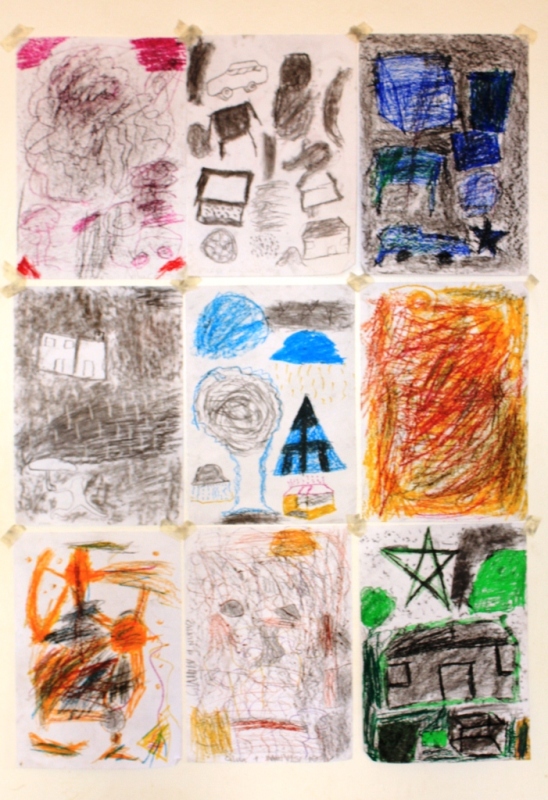
Below is some examples of last week’s Making Marks workshop, this was a great way to get the pupils thinking about how they can develop their own unique styles of art. These skills filtered into the next self portrait exercise where each child was asked to identify their individual characters within their drawings.


Leave a comment

Filed under Uncategorized

Heads up from the Head


Teachers in the background are getting involed in Making Art, Making Me

Yesterday at Mgungani the Head Master, Mr Msofe joined our third workshop at Mgungani Primary School.

We had a jam packed afternoon with some lost ground to make up from last week, despite this the head teacher loved the workshop and I was really pleased to see that he even interjected at the end whilst we were setting some ‘homework’. We were asking them all to draw a picture of something that has happened in their life, good, bad, old or new, it doesn’t matter as long as it has had an impact on their identity and is important to them! As we were discussing this Mwalimu Msofe joined in and reminded the children that they are all individuals and therefore should think about unique stories. This was really fantastic to see the teacher getting involved with the project and put a massive smile on our sustainable face!  We spoke with him afterwards and he reassured us that we are welcome anytime and can see that the children are learning new skills. He especially liked the presentations, our favourite part too, where each child presents what they have done to the group. He says that this is building their confidence and they can use these skills to express themselves in the classroom and in their exams.

Karibu sana Mwalimu Msofe

You are very welcome!

1 Comment

Filed under Uncategorized

Corporal Punishment, Hunger and Learning

In last week’s workshops, the very sensitive and controversial subject of corporal punishment surfaced in many of the drawings. The pupils commented that the children in their pictures were either sad or angry because they had been scolded by the teachers. This cross over between these different feelings ‘she is angry because she is sad’ immediately suggests wrongdoing – anger should not be a product of sadness unless there has been an injustice.

When observing a maths lesson in a primary school last week, a member of Childreach Internationals staff observed a trainee teacher writing equations on the board and repeatedly caning after every wrong answer.  By the end of the lesson there were tears in every child’s eyes. This was a trainee.

Around 2005 the Ministry of Education in Tanzania set out new legal guidelines which stipulated the conditions and reasons why a child is to be caned, for behavioural discipline not learning difficulties.  This was a result of secondary school children starting councils and confiding in teachers and parents.  Finally, after enough complaints had been made about the constant, severe and inappropriate use of corporal punishment conducted by teachers, the Ministry of Education recognised that disciplinary councils should be set up in schools to designate the new ‘motivational punishments’. An example of this could be working in the library or planting a tree and ensuring it grows. This will enable students to recognise and learn from their mistakes rather than fearing them.  Caning is then only to be used in conjunction with a suspension and letter home explaining the behavioural disobedience.

This all sounds fantastic progress on paper but the reality, as shown above, is that these councils are only in place in the more fortunate secondary schools. Caning is still extremely prevalent  and constantly used as a socially excepted teaching strategy, to correct mistakes without explaining the answers.  In rural primary schools where children are unaware of their rights they are disempowered and much more vulnerable to violence. How are children supposed to learn, as opposed to being ‘taught’ if they are not able to understand and reflect on their mistakes.  I asked Lorna Yoyo, Childreach International’s Programme Manager to comment on this, she recalled her memories from school.

                Every time you are being caned, all you think about is the pain, how much your hand hurts. You don’t concentrate anymore. Emotionally I used to feel really low for being caned without reason, I used to cry for this.  You are either crying or hurting in silence during lessons and I don’t see how a child can continue concentrating on their studies after being caned in class.  If anything I’d rather the children’s were caned outside of the classrooms so it is not detrimental to their learning. If they have to be caned then the reasons should be explained, otherwise the children just end up hating the teacher or being afraid. Its fear, fear of the teacher which creates the dislike of the subject.

Lorna also commented on the social consequences that an increased pain threshold and a desensitisation of punishment may incite, children who are used to violence will of course grow up with anger and perpetuate a resentment to learn.  In extreme cases children will stuff exercise books or kanga’s underneath their clothes to protect them from the cane. So instead of the canes shaping their behaviour they become more radical and aggressive. A recent analysis of the physical punishement of children conducted  by the Canandian Medical Assosiation substantiates this, clearly indicating the damaging impact on chidlrens long term development.

The legal boundaries of corporal punishment in schools are incredibly blurred; there are lots of different laws saying lots of different things with no obvious accountability.  Under the UN Convention on the Rights of the Child (CRC), an international treaty to which Tanzania is signatory declares that

States Parties shall take all appropriate legislative, administrative, social and educational measures to protect the child from all forms of physical or mental violence, injury or abuse, neglect or negligent treatment, maltreatment or exploitation, including sexual abuse, while in the care of parent(s), legal guardian(s) or any other person who has the care of the child” (Article 19).

The Tanzanian Government therefore has an international obligation to protect and embed child rights within society. This is addressed in the Law of the Child Act (2009) which states that guardians ‘should protect children from all forms of violence (article 9). However, this article is undermined by article 13, allowing ‘justifiable correction’ which does not exclude all forms of corporal punishment.

Concentration in classrooms is already poor due to lack of food and hunger. The government says that schools should provide food for the pupils but fail to provide a budget for this. Parents are therefore asked to contribute maize and beans every quarter, but often struggle. Last year was particularly difficult due to the East African Drought there was barely a harvest.  Before Childreach International started their school farming project at Mgungani, many teachers thought children were being possessed, it was clear to a nutritionist that these children were malnourished.

There are many barriers to learning in place here.  For some, school is the only chance they get to eat and this hunger tests levels of concentration.   Combined with the pain and fear from caning and exhausting chores like cleaning and collecting firewood it is hardly astonishing that passing standard seven examinations appeared frequently in last week’s happy drawings.

In my final comment I would like to contest the justification of caning by educational professionals as ‘an African thing’, it isn’t. Tanzania inherited corporal punishment from Colonialism which was initially introduced by the Germans in 1886 and upheld by the British who replaced the strap with the cane. In 1952 the British proposed abolition which was reject by local opinion.

Making Art, Making Me will be introducing child rights into our forthcoming workshops, with particualr reference to Article 19.


Leave a comment

Filed under Uncategorized

Drawing Pictures and Feelings.

Last week MME facilitated workshops which helped students develop their own artistic styles by experimenting with lots of different materials in timed drawings. We are using these to encourage freer and more expressive work as there is a tendency to be very restrained and meticulous with their marks. This could be related to the amount of discipline received at school, the Global Initiative to End All Corporal Punishment To Children summarises that in Tanzania,

Government guidelines in 2000 reduced the number of strokes from six to four and stated that only the heads of schools are allowed to administer the punishment, with penalties for teachers who flout these regulations.

However, it seems that there is no accountablity for these flouting teachers, and caning is still common in schools. I met someone yesterday who remembers being caned eighteen times a day because he struggled with mathematics, unsurprisingly he failed the subject.

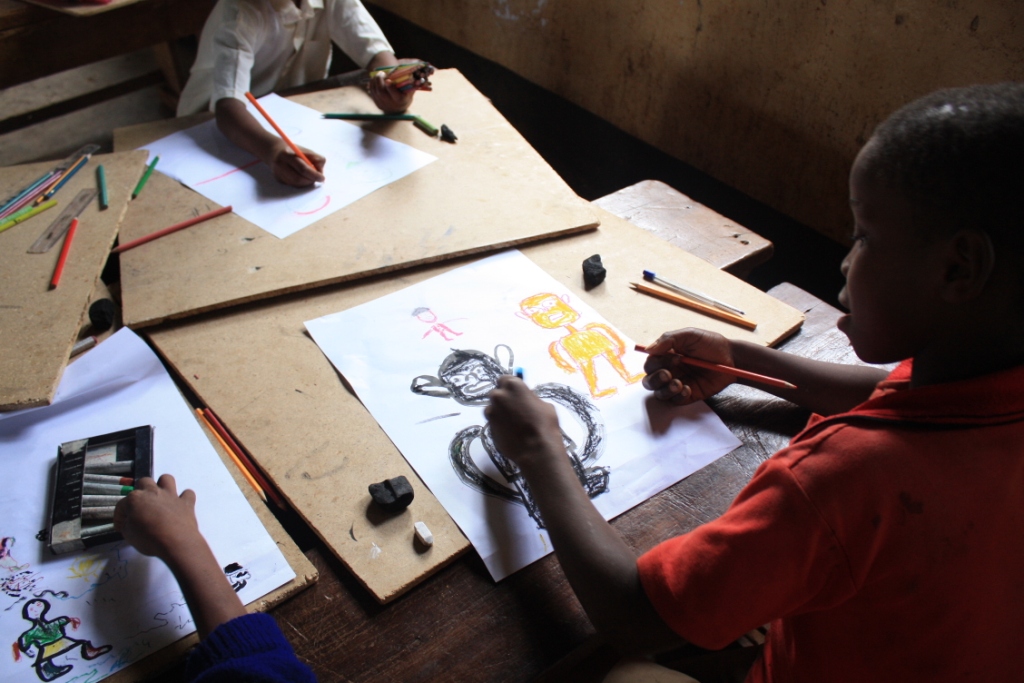
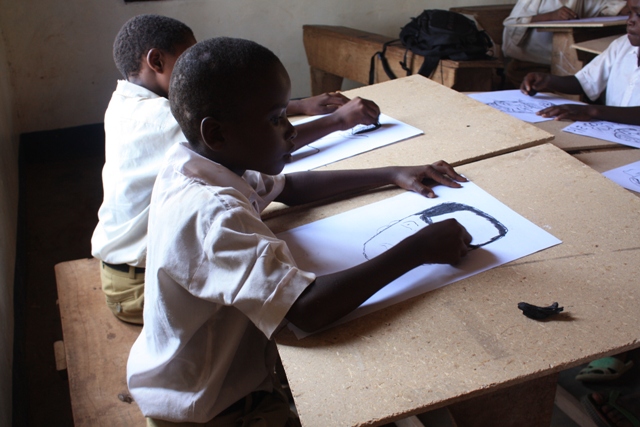
During the workshop the children experimented with charcoal, inks, oil pastels, pens, crayons and chalks. Each material has its own quality and the children were asked to investigate these and test out as many marks as possible. We then went on to discuss how we can put feelings into our pictures, for example what would a happy person look like? Or a sad person? And how about someone who is angry or scared? We can use many different marks, colours, shapes and sizes to explore these ideas, in the image above a boy at Singachini draws someone who is very sad all in black and another with a big frown on his face.

During the group presentation at the end some very intelligent remarks came out, many of the happy drawings were to do with passing standard seven examinations,  you cannot go on to secondary school without these and often families can’t afford to repeat the year. Although primary education is technically ‘free’ many families struggle to find the 70,000 TSH for uniforms, materials and porridge etc. The children identified the colours, facial expressions and body language in their drawings as indicators to particular feelings. There was often a crossover between emotions and one child commented that the girl in the picture was angry because she was sad, others were sad and angry because they had been scolded by the teachers

We will be putting these skills to use in this week’s workshops where each child will be producing their very own self portrait in individual styles and identifying their unique characters, strengths and aspirations.

Leave a comment

Filed under School Visits, The Millenium Development Goals (MDG), Uncategorized

Timed drawings at Mgungani

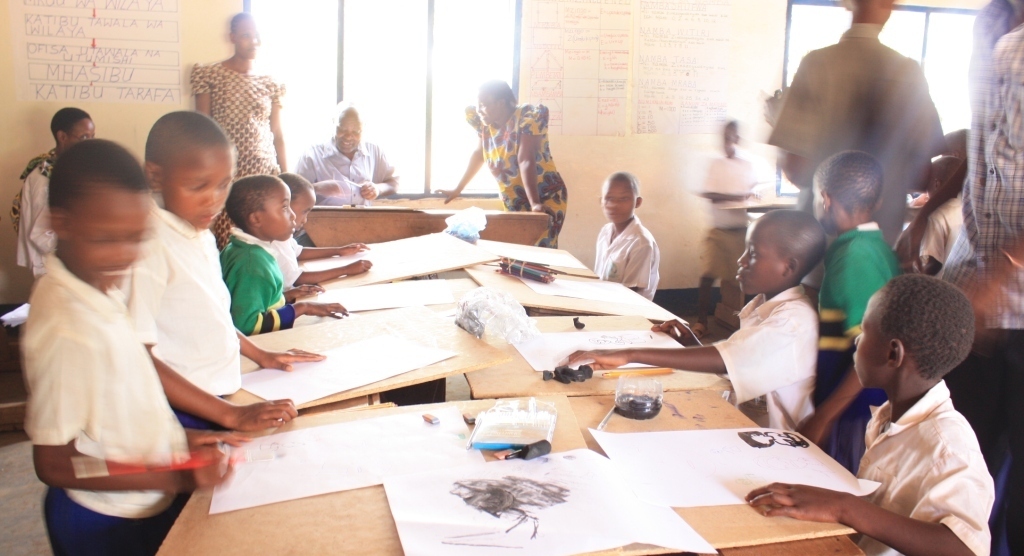
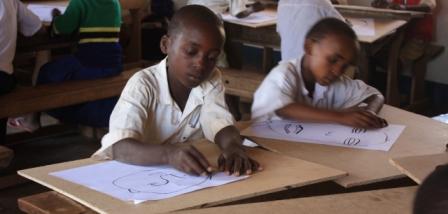
Each child was given a sheet of A3 paper, some charcoal and thirty seconds to draw their partner. These works will form part of my baseline survey and help indicate the children’s development as the project continues. It was very noticeable at Mgungani that the children produced very small drawings, taking several rounds of encouragement for them to increase in size and content. See here for an animation of how the drawings developed as the workshop continued. The ‘drawing game’ consisted of a few rounds of thirty seconds, one minute and one five minute drawing at the end.

Leave a comment

Filed under Uncategorized

First Impressions: Mgungani

Yesterday MME kicked off with our first Kijitanbua (our personal identity) workshop in Mgungani  primary school in semi rural Moshi.  The session started with some very quiet introductions and a drama game to break the ice, Zip Zap Boing.

I could tell the children were a little reserved as they whispered their names whilst clenching their hands in the circle. Despite this, it didn’t take long for smiles to shine and the zips, zaps around the circle encouraged the teachers to join in too!

We continued this format for the rest of the workshop by playing a ‘drawing  game’  which enticed  the children from level 4,5 and 6 (9ys-13yrs) to draw as quickly and expressively as possible.  If in thirty seconds you hadn’t completed a charcoal drawing of your partner sitting opposite, you were out! After each round the drawings got a little bigger and bolder and by the end of the workshop each child produced a fantastic 5 min picture of their rafiki. And no for all you Disney fans, I do not mean the baboon from The Lion King, in Swahili rafiki means friend!

One of our goals and main challenges we will be facing throughout MME is the reticence of the children. This, coupled with the lack of creative learning strategies in Tanzanian classrooms means we have our work cut out for our ‘60 children to demonstrate increased confidence, self esteem and ability to express themselves through art’.  In order for the project to be sustainable we are also working on involving the teachers in the classes, at the beginning of the session questions were answered on behalf of the children and we want them to think for themselves!

Today, Making Art, Making Me will begin in Kibo school, we will be applying our lessons learnt from yesterday and can’t wait to see how the children from urban Moshi respond to their first workshop!

Children sit opposite each other and draw thier partners

Leave a comment

Filed under School Visits, Uncategorized