
Read on for the exciting evaluation interview with the parents of Ibra and Irene from Kibo primary school.
Participants:
R A Msasu, Business Man from Moshi Town, Ibra’s Father
Jane Michevel – Street vendor, Majengo, Irene’s Mother
Anouk Galle – Education Partnerships Manager, Childreach International
Emanuel Ringo – My School, My Voice Coodinator, Childreach International Tanzania
Anouk: Good afternoon, we have invited you here today to ask you some questions regarding the Making Art, Making Me project which Jo has thoroughly enjoyed working on with Irene and Ibrahimu,
Some discussion starts as Ema explains a little about the project, Jane is interested to know what we have been doing and asks if is the same way that the teachers normally teach, or more involvement
Anouk: It seems you already know a little about the project, what has Irene mentioned about the workshops?
J.M Everyday she has been telling stories about what has been going over the last two months. In this time she has changed and upgraded herself. Her manners have improved, she has become more focussed with better behaviour. She has lost her stubbornness and she is now taking care of her things. She isn’t loosing things and keeping things close to her. She’s also been drawing in her exercise books and painting.
Anouk: Has Ibra been talking about the project and what kind of things has he been saying?
R.M: Yes, when this project started again he came up to tell me about it which is using drama and drawing. He really likes this, he even invited me to attend the exhibition but I couldn’t because of work.
Anouk: Have you noticed any change in Ibra since Jan/Feb?
R.M: Yes, he has changed a lot, he likes to read and look at story books and watching story telling on the TV. He also would love one day to learn to write his own stories, to be an author, writing his own books. He’s said all this since the project started .
Anouk: And what about Irene?
J.M: Laughter. Irene would now like to be teacher. Before the project started Irene didn’t even like school, now she loves it and is telling me that we are late in the mornings and that it is time to get to school! During the evenings she is now late getting back from school, not because she is being stubborn but because she reads in the afternoon. Another change is that on Sundays she goes to bible school, she never used to go. She is now attaining other lessons in church and goes for afternoon reading. On Saturdays she goes to do group work with friends. She is concentrating more on her achievements rather than going outside to play, when friends come she tells them she has things to do.
Anouk: The project uses Art to engage with the children, what do you think about Art, do you think it has a use or a purpose?
R.M: The children are able to identify themselves through art, to me this is what art is about, a way to deliver information to others. Even if a person can’t hear at least he can see and understand the full picture from art. I stress the point that if art is to be used then is can be adapted so that when they grow it becomes a benefit, like a life passage. In the beginning I thought this was just a art lesson but actually this is a life skill which they can aspire to in the future. I can see that the skills learnt in this project can be applied to other areas in their lives.
Anouk: What about applying it to different subjects?
R.M: It would be good because they become better informed through practical work.
J.M; Its a good thing because its practical and theory. Practical is better than other ways of teaching, so if it can be applicable to other subject then great.
A.G: Have they heard Ibra or Irene express any new concepts, words or ideas that thy hadn’t heard before?
J.M/ R.M: Both children watch the television and some of the words that come up on the TV they try to translate. They have a better understanding of English and now Irene wants her mother to buy her a dictionary. So even if she guesses a word from the TV she wants to check it out and tell the rest of the family.
Anouk: Have either of the children mentioned anything about child rights or what they made their pictures about.
J.M: – Irene has been collecting the children together to teach them about things. I will often find them together but as a single mother I don’t have time to sit and listen. When Irene comes home and is asking why this and that about rights, I know that this new knowledge and information is helping her.
R.M: Yes, since the start of the project Ibra has been registered at the National Kilimanjaro library office where he is going to pick up books about child rights. Ibra wants to have his own permanent book shelf where he can keep his own books and materials!
J.M: Are you asking all of these questions because of the project or is it because of the children?
Anouk: This is what were trying to find out, we’ve being doing the project for three months and can see the children changing positively and we need to find out if this is because of the project, if so it means we want to see if other people want to get involved for the future.
J.M: And what methodology did you used to bring this change? Whatever it is I think you should keep it there because my daughter has changed so much.
Anouk: Its also important to us to ask the teachers, parents or anyone else important to the children to see what’s changed and if you can give us further feedback or ideas. We need to know if the children are happy, if it is positive, or whether they are they running back to you saying ‘oh my ‘ do we really have to do this again! The evaluation is so we can continue with the project in the best way possible.
J.M: -In two months I haven’t been called into school nor heard bad words from the teachers about Irene. And she has started taking care of her belongings.
A.G: Does this mean before was she hearing bad reports from the school?
J.M: Yes yes, I was getting mad, it was frequent. Even at home when friends came to visit she was shy to greet but now she is more open and is greeting people.I must stress that when I see a negative thing I think it is better to say and speak it out rather to just talk to get something out of it. So if I’ve seen that truly Irene did or did not change I am telling the truth. She really did change and there is no need to lie.
Emanuel explains about the project, presentations/ drawing styles etc ideas/ one minute drawings and presenting them
J.M: They must of been very attentive as we only came for one day of a week, to change a child for only one day a week/ and only 2 or three hours a lesson, it is a big thing. The child keeps it in their mind that next week these people will come again, how are they going to look at me, my belongings, my ideas an things. this child is always attentive of what to do and what tod o next. its actually changed them.
Anouk: Do you want to know a little about how we worked in the project with the children?
J.M. Yes I would like to know about how we did, the methodology but its more about what I’ve seen through my daughter. I would like to know more about how the project plans to continue.
Anouk: So that’s what were doing here today, to see how we an continue building these skills. One of the big differences between the children in the project and children in other classes is that there are fewer children. This isn’t always possible in other classes where there might be 30/40/50 children.
J.M: How were the children selected?
Anouk: Randomly.
J.M: So the method is different which is very good, I think that in the selected 20 a lot of them were stubborn. It seems like the teachers have chosen the most difficult children of all the classes, they have changed so that is a positive thing.
There are some children that will not change, even if you beat them today, tomorrow they will do the same thing. What the difference is that you gave them directions without beating, in a softer manner not rough, with sticks or harsh talk. This has meant that the children are now trying to identifying themselves as now I am the one who is wrong. Even if when they go home they will think that its is not my mother or father who is doing wrong to me, it is myself doing the wrong thing. Because in the class these people are teaching me this different way and I am learning and they are very close to me, why should I go back home and do these bad things, so its me who is bad, so I have to change. I think that’s why the children have been able to change, its more comforting and they came to like the lesson.
Anouk: Thats amazing to here, lots of fantastic information. The project wasn’t just about making the artwork, work in groups in groups and presenting their artwork was just as important.
J.M: So it was like a process, that’s why Irene is saying she wants to be a teacher!
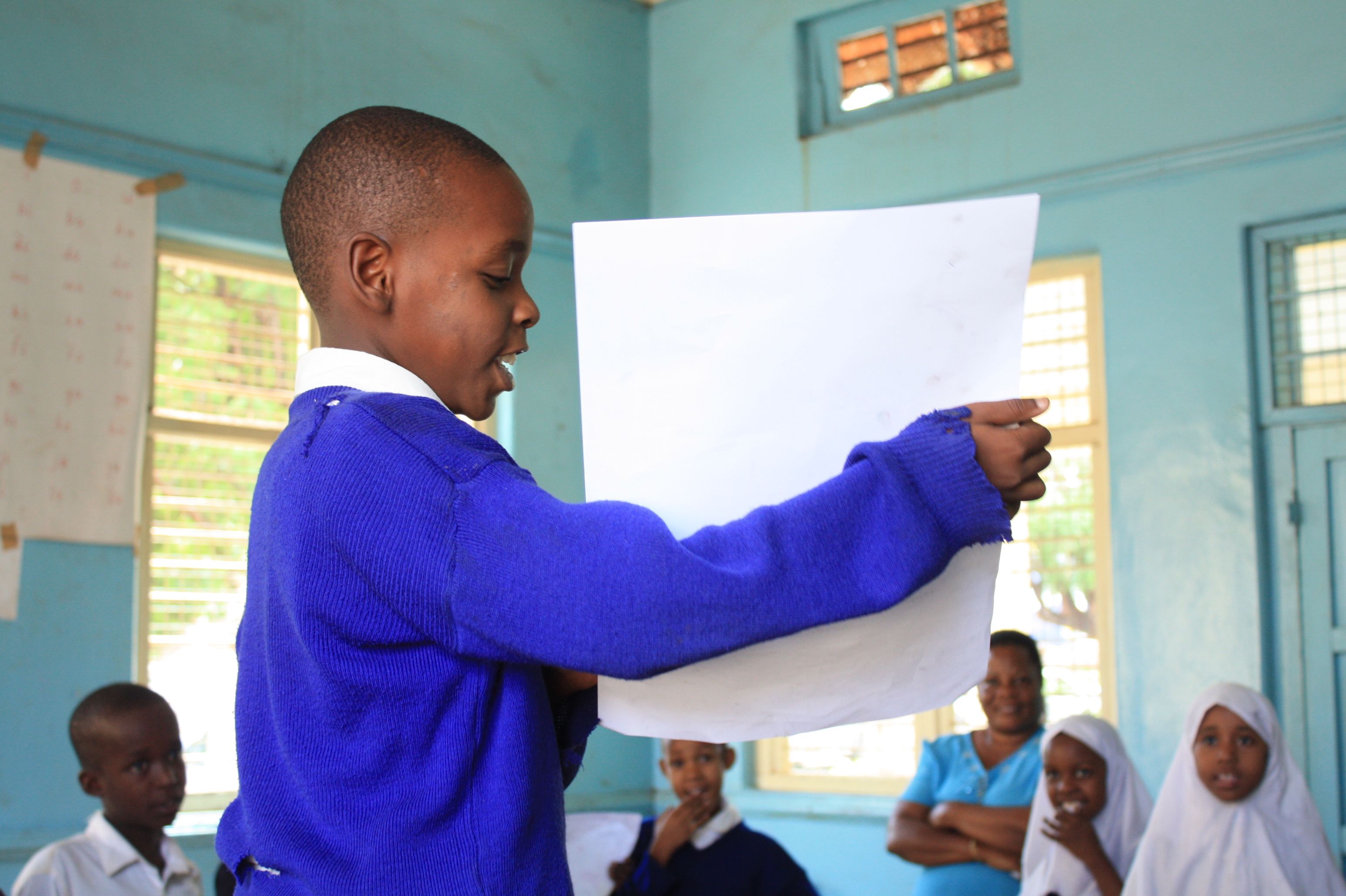
Ibra is pictured here presenting his artwork to his peers and I cant hep but notice the big smile on his teachers face!

 makingartmakingmedotcom